

Hello, team. Adam Steele here.
If you’ve walked into a gym, you’ve probably heard the clanking of weights, the hum of treadmills, and the heavy breathing of people pushing their limits. We spend hours focusing on the mechanics of our bodies reps, sets, macros, and miles. But in my years of coaching everything from elite athletes to complete beginners, I’ve noticed a massive blind spot in the fitness world.
We treat the body like a machine and the mind like a distracted driver. We zone out on treadmills watching TV, or we scroll through social media between sets, completely disassociating from what our muscles are actually feeling.
Here is the hard truth: You cannot reach your full potential physically or mentally if you are operating in a state of disconnection.
The missing link is the mind body connection. It isn’t some mystical concept reserved for yogis on a mountaintop; it is a physiological reality that dictates your performance, your recovery, and your overall happiness. Today, I’m going to walk you through exactly how to rebuild that bridge, specifically tailored for those of you just starting this journey.

Understanding the Basics: What is the Mind Body Connection?
Before we get into the “how,” we need to understand the “what.”
The mind body connection describes the bidirectional communication highway between your brain and your physical form. It’s not just your brain telling your hand to pick up a coffee cup; it is also your gut telling your brain it’s nervous, or your tight shoulders telling your brain you are stressed.
Scientifically, this involves a complex network of neurotransmitters, hormones, and the nervous system. When you are stressed, your body releases cortisol, your heart rate spikes, and your muscles tense. Conversely, when you physically relax your muscles, your brain receives the signal that it is safe to calm down.
When this connection is weak, you might experience:
- Chronic tension you don’t notice until you’re in pain.
- Eating when you aren’t hungry (emotional eating).
- Pushing through injuries because you can’t feel the warning signs.
- A general sense of “brain fog” or lethargy.
Strengthening this connection puts you back in the driver’s seat. It allows you to train smarter, manage stress better, and live a more vibrant life.
The Role of Somatic Awareness in Everyday Life
To strengthen the mind body connection, we have to talk about somatic awareness.
In simple terms, somatic awareness is the practice of feeling your body from the inside out. It is the ability to perceive visceral sensations heat, pulsing, tension, constriction, or expansion without immediately judging them or trying to “fix” them.
Most of us live entirely in our heads. We are constantly planning, worrying, or analyzing. We treat our bodies merely as vehicles that carry our heads from meeting to meeting. Somatic awareness invites you to inhabit the vehicle.
Imagine you are sitting in traffic.
- Without awareness: You are mentally cursing the cars ahead, your jaw is clenched, and your knuckles are white on the steering wheel. You are unaware of the physical toll.
- With awareness: You notice, “Oh, my chest feels tight. My breathing is shallow. My hands are gripping the wheel too hard.”
Once you notice, you have the power to change it. You can’t fix what you can’t feel. Integrating somatic awareness into your day is the first step toward reclaiming physical autonomy.
Simple Mindfulness Techniques to Get You Started
You don’t need to meditate for an hour a day to see results. In fact, for beginners, I recommend starting with “micro-doses” of mindfulness. Mindfulness techniques are simply tools to anchor your attention to the present moment, which naturally brings you back into your body.
Here are three beginner friendly ways to start:
1. Mindful Eating
How often do you inhale a meal while watching Netflix, barely tasting a bite? Try eating one meal a day without screens. Focus on the texture of the food, the temperature, and the act of chewing. This not only improves digestion but forces you to listen to satiety cues.
2. The Sensory Walk
Leave your headphones at home. Go for a ten minute walk. Instead of thinking about your to-do list, focus on your senses. What does the air feel like on your skin? How do your feet feel as they roll from heel to toe? What sounds do you hear?
3. The “Doorway” Trigger
This is a favorite of mine. Every time you walk through a doorway today, take a deliberate check in. Ask yourself: “Where are my shoulders?” If they are up by your ears, drop them. It takes three seconds, but it interrupts the stress cycle.

Biofeedback Basics: Tuning into Your Body’s Internal Signals
When I mention Biofeedback, people often think of hospital machines and electrodes. While clinical biofeedback is a powerful therapy, you can practice biofeedback basics on your own right now.
Biofeedback is essentially the process of gaining greater awareness of many physiological functions primarily using instruments that provide information on the activity of those same systems, with a goal of being able to manipulate them at will. However, we can strip away the machines and use our internal sensors.
Here is how to apply biofeedback basics without a lab:
The Heart Rate Check:
Place your hand over your heart or two fingers on your pulse points. Close your eyes. feel the rhythm. Is it fast? Erratic? Slow?
Now, take five deep, slow breaths. Feel the pulse slow down.
- The lesson: You just consciously controlled an autonomic process. That is the mind body connection in action.
The Thermal Check:
When we are stressed, blood rushes to our vital organs (fight or flight), often leaving our hands and feet cold.
Close your eyes and focus intensely on your hands. Imagine them holding a warm cup of tea. Visualize warmth flowing into your fingertips.
With practice, you can actually raise the temperature of your hands by relaxing the vascular system.
Understanding these biofeedback basics proves to you that you are not a victim of your physiology you are the conductor.
Morning Grounding Exercises: Starting Your Day with Intention
How you start your morning sets the tone for your entire nervous system. If you wake up and immediately grab your phone to check emails, you are instantly putting your brain into a reactive state, severing the connection with your body before you’ve even brushed your teeth.
Try this “Grounding Routine” instead. It takes less than five minutes.
- The Wake Up Wiggle: Before you even get out of bed, wiggle your toes and fingers. Rotate your ankles. Feel the sheets against your skin. Acknowledge that you are awake.
- Feet on the Floor: Sit on the edge of your bed. Place both feet flat on the floor. Push your heels down. Feel the support of the ground. Take three deep breaths, imagining you are drawing energy up from the floor into your legs.
- Hydration Awareness: Drink a glass of water, but do it slowly. Feel the cool liquid travel down your throat and into your stomach.
This routine signals safety to your brain. It anchors you in the physical world before the digital world tries to hijack your attention.
Mindful Movement: Incorporating Gentle Stretching and Yoga
As a coach, I love heavy lifting. But to foster a deep mind body connection, high intensity interval training (HIIT) isn’t always the best tool because it often requires you to push past discomfort.
To build connection, we need mindful movement. This is where gentle stretching and yoga shine. The goal here isn’t to burn calories; it’s to map your body.
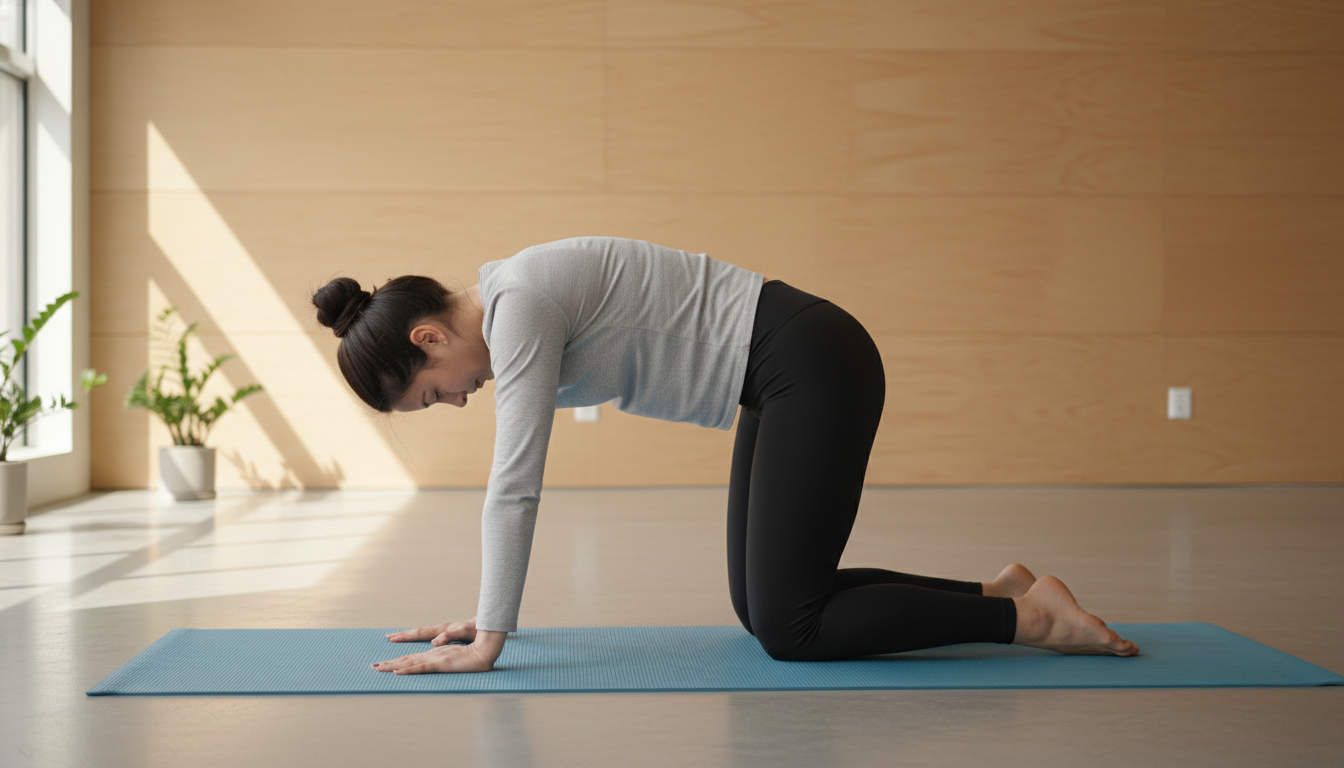
The “Cat Cow” Check-In:
Get on all fours.
- Inhale: Drop your belly, lift your chin (Cow). Feel the stretch in your abdominals and throat.
- Exhale: Arch your back, tuck your chin (Cat). Feel the space opening between your shoulder blades.
Do this for two minutes. Don’t worry about how it looks. Focus entirely on how the spine articulates. Where is it stiff? Where does it move freely? This is data. You are gathering intelligence on your own body.
How to Practice Somatic Awareness During Your Workday
The modern workday is the enemy of the mind body connection. We sit in ergonomic nightmares, staring at blue light, often holding our breath while reading emails.
Here is how to maintain somatic awareness at the office:
The Hourly Scan:
Set a silent alarm on your phone for every hour. When it goes off, do a quick scan from head to toe.
- Is your tongue pressed against the roof of your mouth? Release it.
- Are your glutes clenched? Relax them.
- Are your legs crossed tightly? Uncross them and plant your feet.
The Eye Reset:
Eye strain is a major physical stressor. Every 20 minutes, look at something 20 feet away for 20 seconds. Feel the muscles around your eyes relax. This small physical release sends a signal of calm to the brain.
Sit-to-Stand Transitions:
When you stand up from your desk, don’t just launch yourself up. Feel your weight shift into your feet. Engage your core. Stand up with intention.
The Power of Breathwork for Instant Relaxation
If the mind body connection had a remote control, the breath would be the “volume” dial.
Breathing is the only function of the autonomic nervous system that we can easily control consciously. By changing your breathing pattern, you can manually shift your body from a sympathetic state (fight or flight) to a parasympathetic state (rest and digest).
Technique: Box Breathing
This is used by Navy SEALs to stay calm under pressure.
- Inhale through your nose for a count of 4.
- Hold the breath for a count of 4.
- Exhale through your mouth for a count of 4.
- Hold the empty lungs for a count of 4.
Repeat this cycle four times.
Notice the physical sensation of the air filling the lower lobes of your lungs. Notice the ribcage expanding. This is physically forcing your body to reconnect with the present moment.
Evening Body Scan: Releasing Physical Tension Before Bed
You’ve made it through the day. Now, it’s time to ensure you don’t carry the day’s stress into your sleep. A poor night’s sleep creates a disconnection the next day, fueling a vicious cycle.
The “Progressive Muscle Relaxation” (PMR) technique is the gold standard here.
How to do it:
- Lie in bed on your back, eyes closed.
- Start at your toes. Curl them tight for 5 seconds. Squeeze hard.
- Release suddenly. Feel the rush of blood and the contrast between tension and relaxation.
- Move to your calves. Tense, then release.
- Move to your thighs, glutes, stomach, hands, shoulders, and finally, your face (squeeze your eyes shut).
By physically tensing and then releasing, you are teaching your brain to recognize what “letting go” actually feels like. It is a profound way to solidify the mind body connection right before sleep.

Consistency Over Perfection: Tips for Building a Lasting Habit
Listen to me closely: You will not be perfect at this.
There will be days when you are stressed, reactive, and completely in your head. There will be workouts where you zone out. That is okay. That is human.
The goal isn’t constant, unbroken enlightenment. The goal is quicker return.
When you notice you’ve lost the connection, don’t judge yourself. Just say, “Oh, I was lost in thought. Let me feel my feet on the floor.” Boom. You’re back. That moment of return is the rep. That is the muscle we are building.
Tips for Success:
- Habit Stacking: Attach a mindfulness practice to something you already do. Breathe deeply while your coffee brews. Do a body scan while brushing your teeth.
- Visual Cues: Put a sticky note on your computer monitor that simply says “Breathe” or “Feel.”
- Be Kind to Yourself: If you struggle with mindfulness techniques or feel silly doing them, just laugh it off and try again. Tension feeds on judgment; relaxation feeds on acceptance.
Conclusion: Embracing a More Connected and Balanced Life
Strengthening your mind body connection is the single best investment you can make in your health. It enhances your athletic performance, reduces your risk of injury, manages your anxiety, and helps you enjoy the simple pleasures of life.
It transforms you from a passenger in your own body to the pilot.
Start small. Wiggle your toes in the morning. Breathe deeply before you answer the phone. Feel the stretch when you reach for the top shelf. These micro-moments add up to a macro-transformation.
You have one body and one mind. It’s time they started working together as a team.
Now, go out there, take a deep breath, and feel it.
Yours in health,
By Adam Steele