

In the world of fitness, the “mirror muscles”—the chest, biceps, and abs—often monopolize the spotlight. However, the true architect of a resilient, powerful physique is the posterior chain. Your back is the structural foundation of your body; it protects your spine, dictates your posture, and powers almost every functional movement you perform.
As we age, the importance of back training shifts from pure aesthetics to longevity. A weak back is a precursor to chronic pain, poor mobility, and the dreaded “slumped” posture associated with aging and sedentary lifestyles.
Fortunately, you do not need a gym full of cable machines or heavy barbells to construct a spine of steel. With the right dumbbell back exercises, you can correct imbalances, improve range of motion, and build a back that serves you well into your later years.
This article explores the anatomy of a healthy back, the specific benefits of dumbbell training for longevity, and the nine essential movements you need to incorporate into your routine immediately.
The Anatomy of a Bulletproof Back
To train effectively, you must understand what you are training. “The back” is not a single muscle; it is a complex web of overlapping muscle groups that work in concert to stabilize the spine and move the arms.
1. Latissimus Dorsi (Lats): The largest muscle in the upper body. The lats are responsible for width and the classic “V-taper.” Functionally, they pull the arms down and back (adduction and extension).
2. Trapezius (Traps): A diamond-shaped muscle covering the upper back and neck. The upper traps elevate the shoulders, while the mid and lower traps are crucial for scapular retraction (pulling shoulders back).
3. Rhomboids: Located underneath the traps, these muscles pull the shoulder blades together. Weak rhomboids are often the culprit behind rounded shoulders.
4. Erector Spinae: The columns of muscle running along your spine. These are your anti-gravity muscles, responsible for keeping you upright and protecting the vertebral discs.
5. Posterior Deltoids: While technically shoulder muscles, they function as part of the upper back complex during pulling motions.
Why Dumbbells? The Longevity Advantage
Why choose dumbbells over barbells or machines? While the barbell deadlift is the king of raw strength, it can be unforgiving on the joints and lower back as you age. Machines offer stability but often force the body into unnatural, fixed movement patterns.
Dumbbell back exercises offer three distinct advantages for longevity:
- Unilateral Training: Most people have a dominant side. Barbells allow the strong side to compensate for the weak, leading to structural imbalances and eventual injury. Dumbbells force each side to carry its own load, ensuring symmetrical strength.
- Increased Range of Motion (ROM): A barbell stops when it hits your chest or stomach. Dumbbells can move past the torso, allowing for a deeper stretch and a stronger peak contraction. This increased ROM builds better mobility and muscle quality.
- Joint-Friendly Mechanics: Dumbbells allow your wrists and elbows to rotate naturally during a movement. This freedom reduces repetitive stress injuries in the joints, allowing you to train consistently for decades.

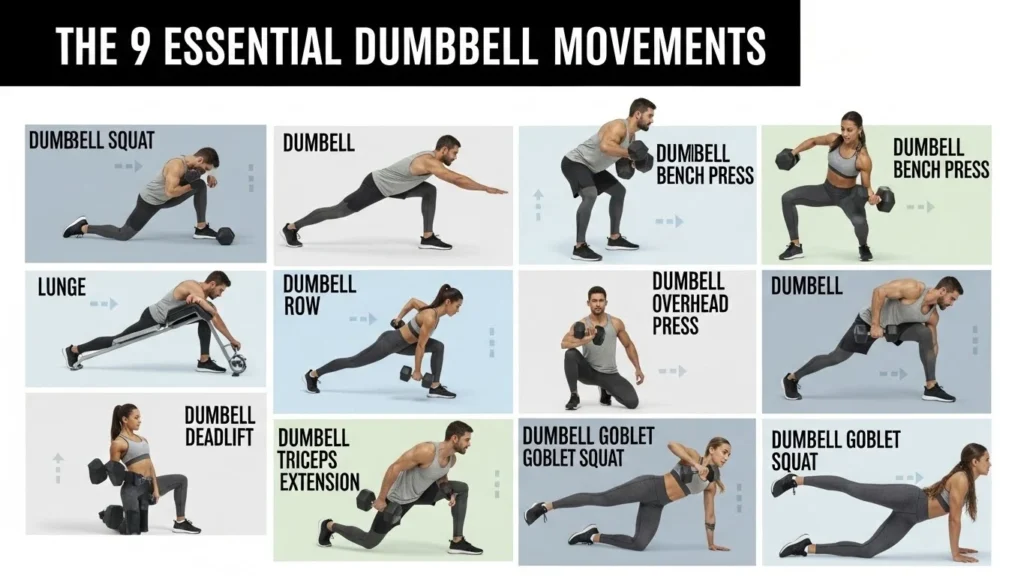
The 9 Essential Dumbbell Movements
These exercises are selected based on functionality, safety, and their ability to hit the entire posterior chain from varying angles.
1. The Single-Arm Dumbbell Row (The Classic)
If you only do one back exercise, make it this one. The single-arm row allows for heavy loading while supporting the lower back, making it safer than the barbell bent-over row.
How to do it:
1. Place your left knee and left hand on a flat bench. Your back should be flat, parallel to the floor (tabletop position).
2. Hold a dumbbell in your right hand with a neutral grip (palm facing your body).
3. Pull the weight up toward your hip—think about “putting the dumbbell in your pocket.”
4. Drive the elbow back and squeeze the lat at the top.
5. Lower slowly for a full stretch.
Longevity Tip: Do not yank the weight or rotate your torso to generate momentum. The anti-rotation aspect of keeping your torso flat engages the core and protects the spine.
2. Dumbbell Romanian Deadlift (RDL)
The RDL targets the erector spinae, glutes, and hamstrings. Unlike a conventional deadlift where you bend the knees significantly, the RDL is a hip-hinge movement that builds a resilient lower back.
How to do it:
1. Stand with feet hip-width apart, holding a dumbbell in each hand in front of your thighs.
2. Keep a slight bend in the knees but do not squat.
3. Push your hips backward as if trying to close a door with your glutes.
4. Lower the dumbbells along your shins until you feel a deep stretch in your hamstrings (usually mid-shin level).
5. Drive your hips forward to return to the starting position, squeezing the glutes.
Longevity Tip: Range of motion is determined by your hamstring flexibility, not by how close the weights get to the floor. If your back rounds, you have gone too low.
3. Chest-Supported Dumbbell Row (Incline Row)
Low back pain is the most common complaint among aging lifters. The chest-supported row eliminates lower back strain entirely, allowing you to isolate the upper back and lats with surgical precision.
How to do it:
1. Set an adjustable bench to a 30 or 45-degree incline.
2. Lie face down with your chest supported by the pad and feet planted firmly on the floor.
3. Hold a dumbbell in each hand, letting your arms hang straight down.
4. Row the weights upward, driving your elbows toward the ceiling and squeezing your shoulder blades together.
Longevity Tip: Experiment with grip. A neutral grip targets the lats; a wide, overhand grip targets the upper back and rear delts, helping correct “hunchback” posture.
4. Dumbbell Pullover
Often debated as a chest exercise, the pullover is actually one of the few movements that work the lats through a vertical plane without a pull-up bar. It is exceptional for opening up the thoracic spine and improving overhead mobility.
How to do it:
1. Lie perpendicular across a flat bench with only your upper back supported (forming a bridge), or lie flat on the bench.
2. Hold one dumbbell with both hands pressing against the inner plate.
3. Start with the weight directly over your chest.
4. Keeping a slight bend in the elbows, slowly lower the weight backward over your head in an arc.
5. Go until you feel a deep stretch in your lats and armpits.
6. Pull the weight back to the starting position using your lats, not your triceps.
Longevity Tip: This movement expands the rib cage and stretches the tight fascia of the upper body—an antidote to sitting at a computer all day.
5. Dumbbell Reverse Fly
This is a corrective exercise. Modern life encourages internal rotation (shoulders rolled forward). The reverse fly strengthens the posterior deltoids and rhomboids, pulling the shoulders back into proper alignment.
How to do it:
1. Stand with feet shoulder-width apart, holding light dumbbells.
2. Hinge at the hips until your torso is nearly parallel to the floor.
3. With a slight bend in the elbows, raise the arms out to the sides like wings.
4. Squeeze the shoulder blades together at the top.
5. Control the descent.
Longevity Tip: Ego lifting here is useless. Use light weights. If you have to swing your body to get the weight up, you are using momentum, not muscle.
6. The Renegade Row
This is a hybrid movement that combines a plank with a row. It builds incredible core stability and anti-rotational strength, which is vital for preventing back injuries during daily tasks like carrying groceries or moving furniture.
How to do it:
1. Assume a push-up position with your hands gripping two hex-shaped dumbbells on the floor. Feet should be wider than shoulder-width for stability.
2. Tighten your core and glutes.
3. Row one dumbbell up to your hip while balancing on the other arm.
4. Keep your hips square to the floor—do not let them twist.
5. Lower the weight and repeat on the other side.
Longevity Tip: If this is too difficult, perform the movement with your knees on the ground. The goal is pelvic stability, not just moving the weight.
7. Dumbbell Shrugs
The upper traps often hold tension, but they also support the neck. Strong traps act as a cushion for the cervical spine. However, many people perform these wrong by rolling their shoulders.
How to do it:
1. Stand tall holding heavy dumbbells at your sides.
2. Keep your arms straight.
3. Elevate your shoulders straight up toward your ears. Imagine trying to touch your traps to your ears.
4. Hold the squeeze at the top for 2 seconds.
5. Lower slowly.
Longevity Tip: Do not roll your shoulders forward or backward. This places unnecessary shearing force on the rotator cuff. Up and down is the only way.
8. Single-Leg Dumbbell RDL
Balance tends to decline with age. The Single-Leg RDL attacks the posterior chain while simultaneously challenging your balance, proprioception, and foot strength. It is a “prehab” powerhouse.
How to do it:
1. Stand on your right leg, holding a dumbbell in your left hand (contralateral loading) or both hands.
2. Keep a soft bend in the right knee.
3. Hinge at the hips, extending your left leg straight back while lowering the torso.
4. Try to form a “T” shape with your body.
5. Return to standing by driving through the right heel and engaging the glute.
Longevity Tip: Focus your eyes on a spot on the floor about 3 feet in front of you to maintain balance. This move uncovers and fixes left-to-right strength asymmetries.
9. The Farmer’s Carry
While arguably a full-body exercise, the Farmer’s Carry places a massive isometric demand on the upper back, traps, and lats to keep the spine upright against a heavy load. It also builds grip strength, which is statistically correlated with lower all-cause mortality rates.
How to do it:
1. Pick up the heaviest dumbbells you can safely hold.
2. Stand tall, chest out, shoulders back.
3. Walk for distance or time (e.g., 40 meters or 60 seconds).
4. Do not allow the weights to swing or your posture to slouch.
Longevity Tip: Imagine a string pulling the top of your head toward the sky. This reinforces perfect postural integrity under load.
Programming for Structural Integrity
To build a bulletproof back using these dumbbell back exercises, you shouldn’t train like a powerlifter (1-3 reps) or purely like a bodybuilder (constant isolation). You need a hybrid approach.
The “Bulletproof” Protocol:
- Frequency: Train your back twice a week.
- Volume: 3 to 4 exercises per session.
- Rep Range:
- Compound moves (Rows, Deadlifts): 8–12 reps (Hypertrophy and Strength).
- Isolation/Postural moves (Reverse Fly, Shrugs): 15–20 reps (Endurance and Stability).
- Tempo: 3-1-1. Take 3 seconds to lower the weight (eccentric), pause for 1 second at the stretch, and take 1 second to lift. The eccentric phase is where the tissue remodeling happens.
Sample Routine A (Thickness & Strength)
1. Single-Arm Dumbbell Row: 3 sets of 8–10 reps.
2. Dumbbell RDL: 3 sets of 10–12 reps.
3. Farmer’s Carry: 3 rounds of 60 seconds walk.
Sample Routine B (Width & Posture)
1. Dumbbell Pullover: 3 sets of 12–15 reps.
2. Chest-Supported Row: 3 sets of 12–15 reps.
3. Reverse Fly: 3 sets of 15–20 reps.
4. Renegade Row: 3 sets of 8 reps per side.

The Mind-Muscle Connection: The Secret Sauce
When training chest or biceps, you can see the muscle working. The back is different—you cannot see it. This makes the “mind-muscle connection” vital.
Many people perform dumbbell back exercises but actually use their biceps to move the weight. To prevent this, think of your hands as “hooks.” Do not squeeze the dumbbell tightly; instead, focus on driving your elbows back or down. The arm is merely a lever; the back is the engine.
Common Mistakes to Avoid
1. Rounding the Spine: This is the fastest route to a herniated disc. Always maintain a neutral spine. If you cannot maintain a flat back, the weight is too heavy.
2. Using Momentum: Swinging the weight up uses kinetic energy, not muscle tension. It reduces the effectiveness of the exercise and increases injury risk.
3. Neglecting the Eccentric: Don’t let gravity drop the weight. Fight the weight on the way down. This eccentric loading strengthens the tendons and ligaments, which is crucial for longevity.
4. Ignoring the Scapula: For rows and flys, the movement starts at the shoulder blade, not the elbow. Move the shoulder blade first, then follow through with the arm.
Conclusion
Building a bulletproof back isn’t about achieving a personal best on a one-rep max or looking intimidating in a tank top (though those are nice side effects). It is about creating a structural shield for your spine. It is about ensuring that at age 60, 70, and beyond, you can pick up your grandchildren, carry your groceries, and stand tall without pain.
By integrating these nine essential dumbbell back exercises into your weekly routine, you are investing in your physical future. The dumbbells provide the tool, gravity provides the resistance, but your consistency provides the armor. Start light, focus on form, and build a back that stands the test of time.